When most people talk about a vehicle’s fuel economy or efficiency, they’ll often talk about how efficient its engine is. However, when it comes to hybrid EVs, gains in vehicle efficiency come from improvements across the whole powertrain.
In this article, we’ll look at how improvements in one component in the powertrain can have a real impact overall: the electric motor.
What do motors do in hybrids?
All hybrids include at least one electric motor. In fact, the electric motor is at the core of what differentiates a hybrid from a traditional pure-combustion vehicle.
Owing to the physics of engines, it takes time for their crankshafts to build up angular momentum from rest or low speeds. This time window is one of the more inefficient phases of engine operations, since the crankshaft will transfer far less energy from burn cycles than usual while it builds up momentum. This is why idling, starting, and low-speed driving disproportionately burns more fuel and results in engine wear-and-tear.
The history of hybrids as we know them today began when automakers began mounting motors directly onto the ends of engine crankshafts. That’s because, unlike a combustion engine, electric motors can instantly switch from rest to outputting their full torque and power. This means that an electric motor can rapidly increase a crankshaft’s angular momentum, allowing it to efficiently begin transmitting the energy released in the engine cylinders.
This was the foundation of what we now call mild hybrid EVs (MHEVs). However, along with supporting the crankshaft, the instant power and torque of hybrids also allowed them to potentially provide power to the vehicle wheels in addition to engine power.
By adding these larger traction motors to a MHEV, in addition to the starter motors at the crankshaft, we get a full hybrid EV (FHEV). And then, by adding a larger battery that can be recharged from mains electricity to an FHEV, a vehicle can be powered by solely an electric motor for extended periods, resulting in a plug-in hybrid EV (PHEV).
Read more about what makes up a hybrid powertrain?
How do motor innovations help hybrids?
MHEVs and FHEVs both feature small batteries, reflecting the fact that their electric motors don’t independently power their vehicles and so can be continuously discharged and recharged. To do this, they take advantage of the fact that a motor can be used as an electric generator if the direction of energy flow is reversed: rotational energy put into a motor can produce an electrical current to top of the battery. For an MHEV, this allows the engine to recharge the battery directly; for an FHEV or PHEV, this allows car batteries to be recharged through regenerative breaking.
This means that a motor’s efficiency allows more energy from the engine, battery charge, and regenerative braking system to be used to propel a vehicle. As a result, the more efficient a motor is at turning electricity into rotational energy – or vice versa – the less fuel or charge demanded per mile by a hybrid.
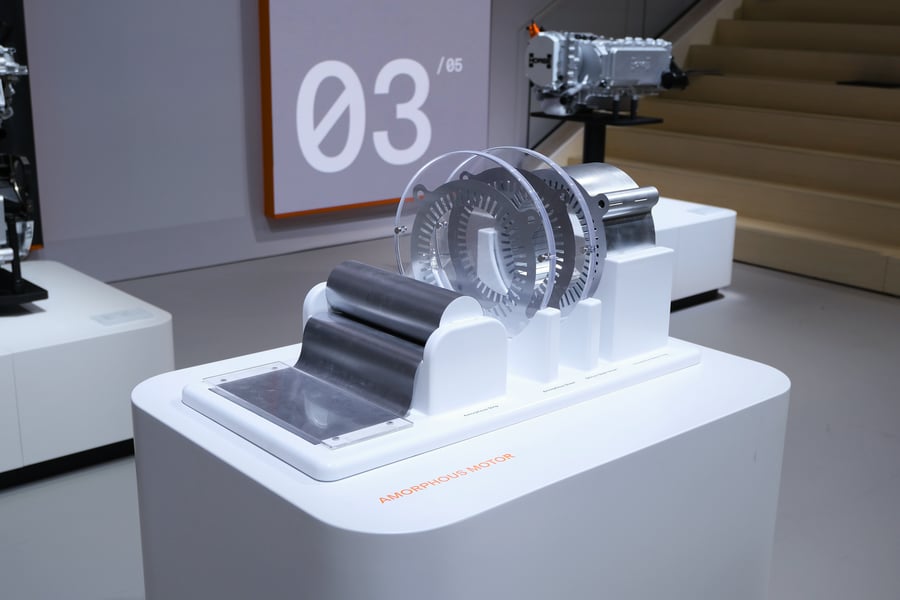
Our amorphous motor is able to achieve an industry-leading efficiency of 98.2%
Read more about what's the difference between HEV, PHEV and REEVs?
Horse Powertrain’s amorphous motor technology
Last year, at IAA Summit in Munich, we debuted to the world a new motor designed to help raise the efficiency of hybrid powertrains: our new amorphous motor technology.
Motors are made up of a rotor that outputs or inputs kinetic energy via angular momentum, and a stator that outputs or inputs electrical energy. Stators are made up of many ultra-thin layers of iron or steel that provide a permeable path for the magnetic field lines for the motor. The thinner these layers are, the more permeable the path for the magnetic field, and the less energy is lost as waste heat by the motor.
Our amorphous motor uses a novel alloy called amorphous steel, which can be produced in layers just one-tenth the thickness of the layers used in traditional rotors. This industry-first deployment of amorphous steel has tremendous results: our initial amorphous motors can cut the amount of energy lost in the motor’s stator iron by a full 50.
With this reduction in thermal losses, the motor is able to achieve an industry-leading efficiency of 98.2%. That means for every 100 joules provided to the motor, 98.2 joules are outputted as useful work. For a hybrid, these levels of efficiency have real impact on emissions and fuel economy, enabling a 1% reduction in whole-vehicle fuel consumption.
Read more about why does thermal efficiency matter?
Hybrid powertrain solutions
Technologies like the amorphous motor are a showcase of how important basic research and R&D continues to be for hybrid powertrains, and also shows how Horse Powertrain’s full-system approach is key to making the most out of these innovations.
If you want to find out more about Horse Powertrain and our motor and engine technology, take a look at our range of solutions here.