At Beijing Auto Show 2026, we revealed our new HORSE D20 Methanol powertrain. This integrated engine and generator unit is designed to recharge the batteries of range-extended EVs (REEVs), using 100% methanol fuel blends.
The D20 Methanol achieves a remarkable fuel-to-energy conversion of 47%, meaning that for every ~2.1kWh of methanol burned it’s able to recharge 1kWh of battery energy. This means the powertrain can recharge a full 40kWh battery pack with just 3.8 US gallons of methanol – which is roughly equivalent to 1.8 US gallons of gasoline.
There are a range of technologies that make this efficiency possible. Much of it can be found in the D20 Methanol’s engine. Solutions like the engine’s high-energy ignition system allow it to burn methanol at very high air-to-fuel ratios, reducing the amount of fuel needed to provide raw mechanical power.
However, there’s another key technology innovation in the D20 Methanol that allows it to achieve its levels of efficiency: its motor-generator. Specifically, it is one of the first uses of an axial flux motor in a mass-market powertrain.
Stators and rotors
The first modern examples of electric motors were developed in the 1820s by inventors and engineers. Ever since then, a core principle of how motors work has remained unchanged: every motor consists of two central parts, the stator and the rotor.
- The stator is the non-rotating part of a motor. In most motors, it serves as both a large block of iron to conduct a magnetic field, and provides a location for the windings – tight coils of wiring, typically copper – to conduct an electrical current.
- The rotor is the rotating part of the motor. Through an electric current passing through its own set of windings or a set of permanent magnets, it is designed to spin in place in response to a magnetic field passing through it.
In most motors, electrical current passing through the windings of the stator generates a magnetic field, which then pushes against the rotor and causes it to spin and produce torque.
If we take the reverse approach by applying torque to a rotor, then it will produce a magnetic field through the stator that will in turn produce an electrical current in the copper windings – turning it into a generator.
Read more about how do hybrid transmissions work?
Radial flux motors
Most motors as we know them are designed as radial flux systems: the stator and rotor are two cylinders, one nested within the other – typically with the rotor being the “inner” part. These motors are called “radial flux” because of the pattern of the magnetic field lines that pass through the stator, which are pointed outwards – radially – from its axis of rotation.
For a range of practical engineering reasons, radial flux motors have dominated. Reasons have included greater ease in manufacturing the materials needed for a radial flux system compared to alternative designs, and an ability to easily scale up a motor’s power by simply increasing its length.
Particularly key to the success of the radial flux architecture is that the “air gap” between the stator and the rotor is easier to maintain, which is crucial to ensuring that the motor doesn’t destroy itself from the rotor and stator colliding. The reason why comes down to geometry: in a radial flux system, the magnetic attraction between rotor and stator at any one point of the rotor circumference is canceled out by the attraction at the other side of the rotor.

A core principle of how motors work - every motor consists of the stator and the rotor - has remained for two centuries
Read more about hybrid powertrain layouts.
Axial flux motors
In recent years, however, hypercars and motorsport vehicles have increasingly experimented with the use of axial flux motors. In these motors, the rotor and stator exist as disks stacked atop one another, with magnetic fields that are pointed in parallel to the axis of rotation – axially, hence the name. One of the most exciting and commonly explored axial flux designs is the use of a “yokeless” motor, consisting of two rotor disks surrounding a single stator.
This configuration maximizes the magnetic surface area for either motor or generator applications. This means that an axial flux motor of the same mass as an equivalent radial flux motor will be able to produce more power – either mechanically or electrically.
However, this does come with new engineering challenges. Among other things, axial flux motors require more careful machining and manufacturing techniques to produce, and typically require far more elaborate control and power electronic systems to regulate. The main reason for this is due to an axial flux motor’s air gap not having the same self-regulating qualities as a radial flux system: meaning that small imprecisions in manufacturing, or faults during operation can quickly destabilize the gap.
Read more about how motor innovations can improve hybrid efficiency.
Taking axial flux motors mass market
For these reasons, axial flux motors have typically been constrained to vehicles that have high performance demands and higher budgets for ultra-precise manufacturing. In the HORSE D20 Methanol, we’ve produced one of the first axial flux motors for use in a mass-market powertrain for consumers.
The result is that, compared to an equivalent radial flux motor, the D20 Methanol’s motor is 46% shorter and can output 63% more power per unit of volume. Along with efficiency gains, this means that the D20 Methanol benefits from some significant packaging opportunities owing to the system’s compactness.
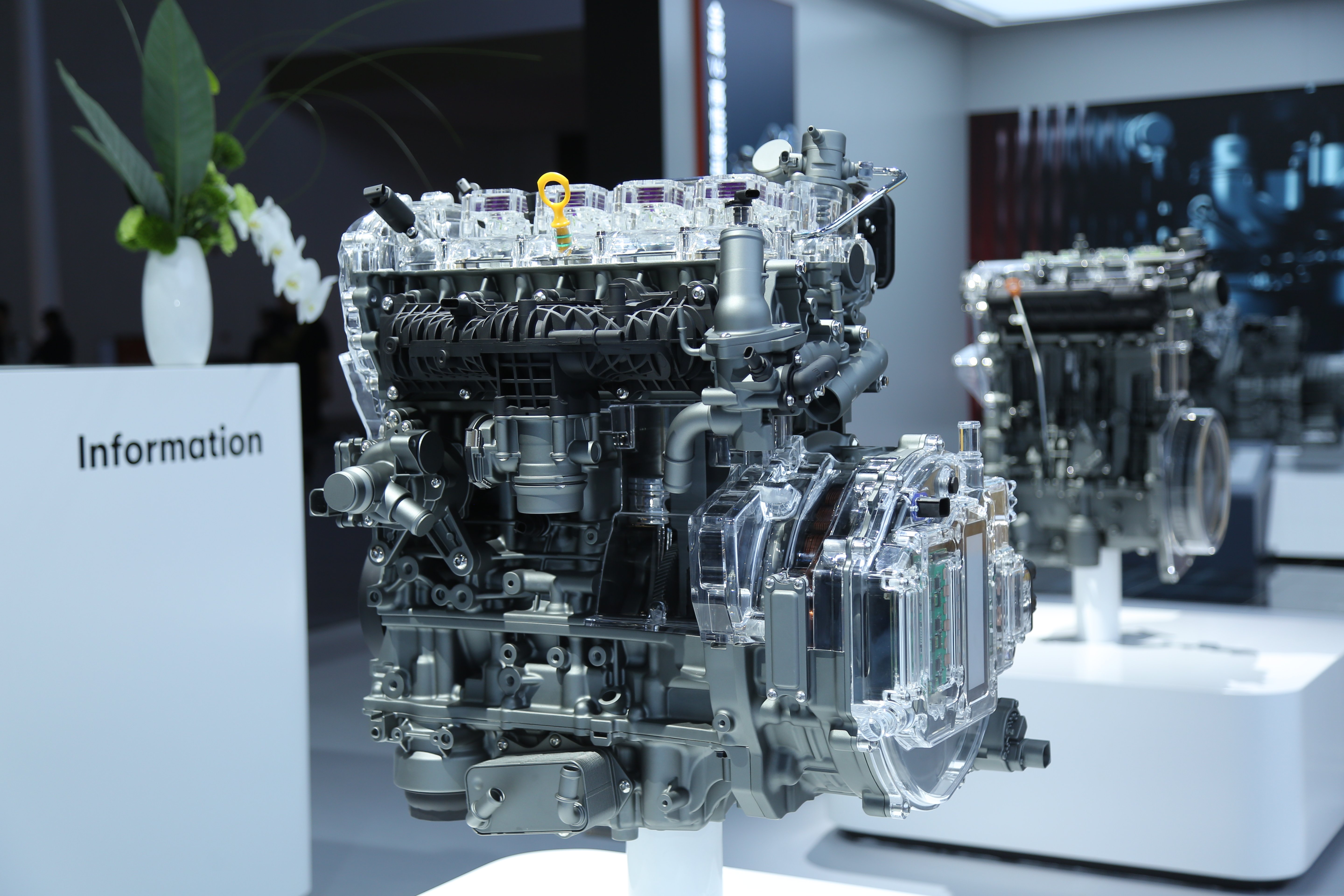
In the HORSE D20 Methanol, we’ve produced one of the first axial flux motors for use in a mass-market powertrain for consumers
It’s no coincidence this motor is featuring in a REEV powertrain: these generators are an ideal first application for axial flux systems, since the powertrain will be operating at a narrow and consistent power level of around 105kW. This means that the control systems for the motor can be optimized to ensure safe operations at that level, whereas a motor connected to the wheels needs to be able to handle a far wider range of conditions.
As said by our CTO, Fortune Zhao, the D20 Methanol is a bold statement of intent by the Horse Powertrain team. Along with the exciting use of an axial flux motor, the engine and control technology present in this new powertrain open up some exciting opportunities for alt-fuel REEVs – allowing drivers to enjoy all the benefits of a full EV experience, with none of the downsides when it comes to range or flexibility.
Find out more about our next-generation powertrain solutions here.