
Passenger cars account for over 10% of CO2 emitted by modern civilization. This means any attempt to bring greenhouse gas emissions under control – namely, the 2050 net zero target of the Paris Agreement – needs to include significant transport decarbonization. But how exactly can automakers do this while maintaining their commercial viability?
Last week, the Financial Times' opening panel of their 2026 Future of the Car Summit tackled this question – and how the answer to it has evolved in the face of the rapid technological, regulatory, and economic shifts of the last few years.
Joining the panel was Horse Powertrain’s CEO, Matias Giannini. Moderated by the FT’s Alice Hancock, Matias spoke alongside:
- Michael Lovatt, Chief Purchasing Officer of Volvo Group
- Benjamin Krieger, Secretary General of the European Association of Automotive Suppliers
- Peter Grünenfelder, President of the Association of Swiss Automobile Importers
Together, the panel focused on what the automotive industry of today needs to do to ensure it plays its part in emissions reduction while remaining financially sustainable.
Decoupling decarbonization from EVs
Matias opened the panel by discussing how there has been a mindset shift over the past year by much of the industry.
For the first half of the 2020s, many automakers treated decarbonization as synonymous with accelerating the rollout of electric vehicles – specifically, battery electric vehicles (BEVs). Now, however, the industry has realized that the realities of technology and demand mean that while BEVs remain a critical tool to reduce transport emissions, they can’t decarbonize transport alone. That’s because by 2040, over half of vehicles on the world’s roads will still feature an engine of some sort.
This means that the industry literally cannot afford to neglect hybrid and combustion vehicles – and not just from a financial perspective, but from a carbon perspective. Failure to develop innovations that reduce the emissions intensity of these vehicles will undermine any attempt to decarbonize the global transport system. The choice at hand is not whether these vehicles will be on the road in 2040. Instead, it’s whether we choose to reduce the emissions intensity of these vehicles or not.
That means that any push to BEV and EV adoption needs to be paired with making sure the next generation of hybrid and combustion vehicles are as efficient as possible. Otherwise, the outcome is just a delay to transport decarbonization.
Horse Powertrain CEO Matias Giannini featured in the FT panel 'Maintaining commercial viability in the race to zero emissions'. Footage provided by FT Live.
Read more about how hybrids can speed up decarbonization
Dealing with a complex new world
However, there’s a challenge here: this means accepting a multi-powertrain world. Rather than seeing hybrids and combustion vehicles as a transitional technology, automakers will need to find a way to cater to the demand for different powertrain categories – a mix of BEVs, hybrids, and plug-in hybrids.
This throws up all new challenges. How can automakers predict the split in demand between different powertrain categories and get a reliable return on investment? How do they deal with the fact that they’ll need to multiply their spend on factories and assembly lines to provide options for each powertrain category?
Matias argued this is why solutions like Horse Powertrain’s X-Range family are so important – mechanisms that allow a BEV platform to serve as the foundation for a hybrid, plug-in hybrid, or range-extended EV. This allows automakers to dramatically cut the costs and complexity with multi-powertrain offerings, concentrate their investment on high-differentiation features, and respond more flexibly to market demand.
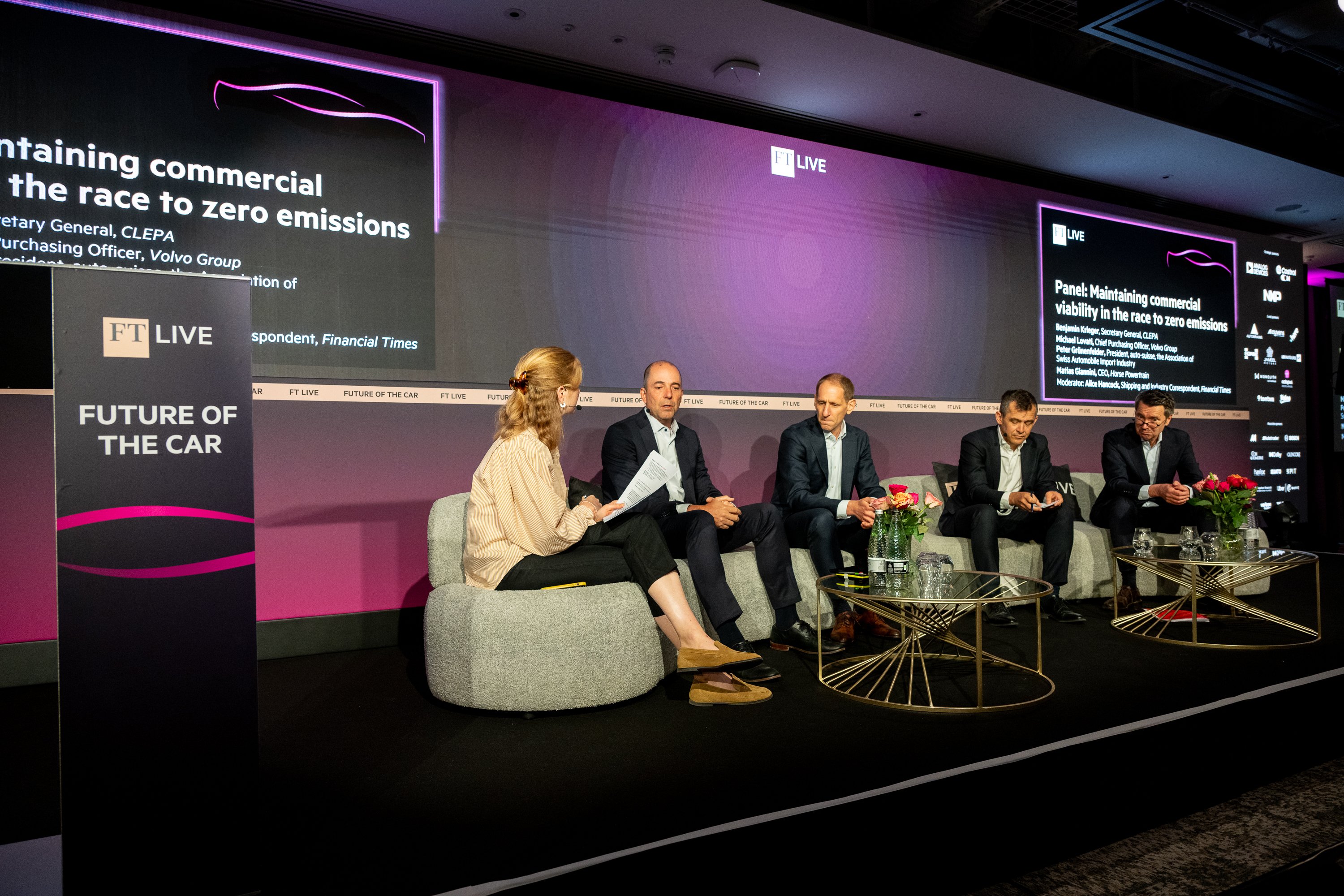
From left to right: Alice Hancock, Matias Giannini, Michael Lovatt, Benjamin Krieger, Peter Grünenfelder
Read more about why automakers should hybridize their BEVs
Commoditizing systems
Responding to market demand is particularly important when looked at in a regional lens. For many markets that are reliant on carbon-intensive energy sources for electricity, or that are mostly rural and lack the grid infrastructure, the demand in favor of traditional combustion and hybrid vehicles will skew far higher than that of EVs. Matias noted that this is a huge challenge for OEMs that need to sell significant volumes of vehicles to achieve profitability.
For automotive brands, Matias argued that the best answer to this is collaboration with the supply chain to meet regional needs. But this means accepting something that’s traditionally proved tough for many automotive brands: treating components like the powertrain as an interchangeable commodity that isn’t a source of differentiation.
To make this point, Matias noted that a large share of vehicles sold today use what is functionally the same engine: with a displacement between one and two liters and a cylinder count between three and four, with a broadly similar performance profile owing to emissions and fuel economy regulations. While many brands rightfully are proud of their engineering heritage, the often uncomfortable truth is that this level of standardization means that these powertrain systems no longer are distinguishable to consumers. The direction of travel can be seen best in China, with most combustion vehicles there using 1.5-liter engines.
The logic at this point, then, is to turn to economies of scale – rather than reinventing the wheel (or, in this case, the powertrain) – the best strategy for automotive brands is to free up capital spent on low-differentiation, commoditized systems to higher-return investments. Teams like Horse Powertrain can then pool the capital, plants, and engineering knowledge of the industry to both roll out improvements in fuel economy, performance, and emissions levels while also pushing down costs due to economies of scale.
Read more about why the 80/20 rule is reshaping powertrain strategy
Achieving 80 with 50
At this year’s Beijing Auto Show, Matias and the Horse Powertrain team made the case that if the industry plays its cards right it could make dramatic progress in decarbonization by 2040. In fact, it could achieve a result equivalent to substituting 80% of all cars on the planet with BEVs.
The key is equivalent to, however. Because the realities of demand, infrastructure, and raw resources mean that BEVs are only going to be able to make up 50% of the global car fleet in 2040. The other half will be hybrid and combustion vehicles.
And it’s through a 20-25% thermal efficiency gain in the powertrains for this half of the global vehicle parc that we can achieve an emissions outcome equivalent to 80% BEV adoption. That means that commercial viability in the face of net zero doesn’t just mean continuing to invest and collaborate around these technologies – it means that the path to net zero itself depends on them.
If you’re interested in seeing why and how Horse Powertrain is focusing on thermal efficiency, you can read more here.
To learn more about Horse Powertrain products, check out our Spotlight Solutions.