Starting from the late 2010s, global automakers made a concerted shift towards electrification – for several years, many brands committed themselves to fully replacing their combustion and hybrid model lineups with battery electric vehicles (BEV).
However, even in markets like Europe and China where BEV adoption has been widespread, there has still remained persistent consumer demand for internal combustion vehicles (ICEs) and hybrid electric vehicles (HEVs). At the same time, many regions have found that a complete shift to BEVs will only be achievable after decades of further investment in grid infrastructure and low-carbon energy systems, meaning that ICE and HEV solutions will remain a major part of their vehicle parcs for decades to come.
For the automakers that initially bet on a pivot to an all-BEV future, this created a problem. To maintain market share, brands now need to provide a diverse multi-powertrain vehicle lineup. However, the way that automakers have traditionally delivered BEV and ICE/HEV models has demanded parallel production capacity for each – different assembly lines, different R&D teams, and different vehicle design.
Horse Powertrain’s X-Range
To address this, we at Horse Powertrain envisioned a solution: hybridizing BEVs.
Instead of treating an HEV powertrain as an iteration on traditional ICE powertrains, we would draw on our deep knowledge of engine, transmission, motor, and power electronics technology to create a single all-in-one hybrid powertrain. We could bring together what was once a full powertrain spread across a vehicle into a single unit with one housing, unlocking major space and mass efficiencies. With these new efficiencies, an all-in-one HEV powertrain could then fit into a BEV platform without the need to comprehensively re-engineer the wider vehicle.
This is the idea of the Horse Powertrain X-Range. By providing a convenient suite of solutions to convert BEVs into hybrids, OEMs could reduce the need for dual powertrain production pathways – instead, they could use a shared foundation for their BEV, PHEV, HEV, and range-extended EV lineups.
The X-Range’s first product was first seen by the wider world at Shanghai Auto Show 2025, with the HORSE X-Range F15 Direct Drive (F15DD): a complete hybrid powertrain that replaced the front drive unit of a BEV, transforming it into a HEV, PHEV, or range-extended EV.
At IAA Munich 2025, we followed this up with the HORSE X-Range C15. This was a suitcase-shaped engine and generator unit that could be inserted in a variety of places across an existing BEV, turning it into a range-extended EV.
Then, at Beijing Auto Show 2026, we took the compact suitcase-shaped foundation of the X-Range C15, and expanded it to mirror the philosophy of the X-Range F15 Direct Drive. By adding a transmission and direct driveline connection, this resulted in the HORSE X-Range C15 Direct Drive (C15DD).
Horse Powertrain Innovation VP Guillaume Tuffier discusses the C15 Direct Drive at the Beijing Auto Show 2026
Read more about why hybrids will stay central to global mobility
How does the C15 Direct Drive work?
A typical BEV includes both front and rear drive units, each comprising a motor, inverter, gearbox, and associated components. Where the F15DD replaces the front unit, the C15DD is designed to replace the rear electric drive unit.
The C15DD packages several components into a single, compact unit with a shared housing. These include a 4-cylinder, 1.5‑liter engine, a transmission, power electronics, and two electric motors. The engine can be installed either in naturally aspirated form for lower‑power applications or with a turbocharger for use in larger D‑segment vehicles.
The two motors are arranged in a P1 + P3 configuration, meaning one motor is attached to the end of the engine’s crankshaft, while the second is fitted to the transmission’s output shaft. Depending on whether the C15DD is naturally aspirated or turbocharged, the P1 motor can serve as either a 70kW or 110kW generator. On the other hand, the P3 traction motor powers the wheels, either in combination with the engine in parallel mode, or operating independently.
The system has been designed so that the exhaust and after‑treatment components can be packaged compactly within the rear of the vehicle, maximizing available floor space for batteries or the passenger compartment.
The result is a full hybrid vehicle capable of operating in rear‑wheel drive, or all‑wheel drive configurations when used alongside an electric drive unit at the front of the vehicle.
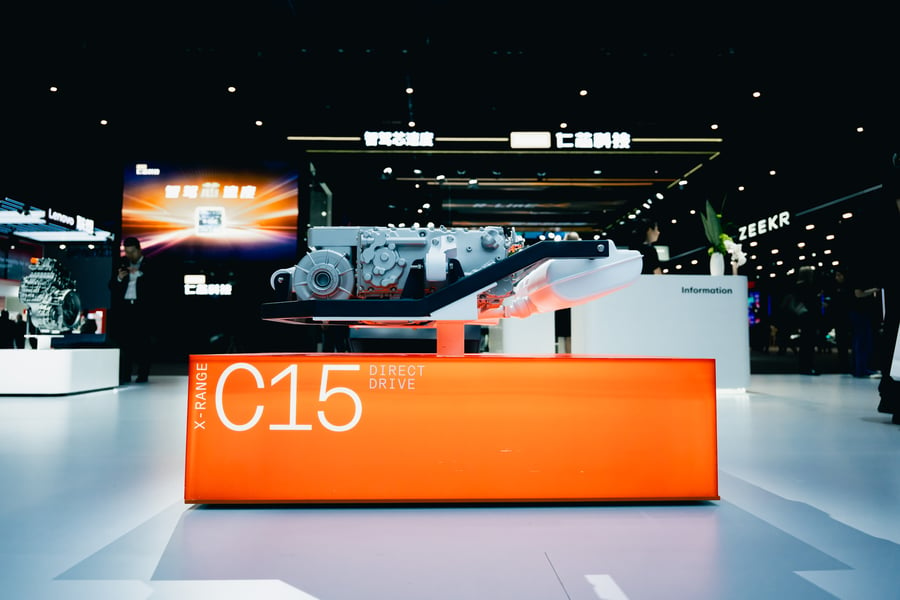
The C15DD packages several components into a single, compact unit with a shared housing
Read more about what makes up a hybrid powertrain
The X-Range family
Each part of the X-Range family caters to a real engineering challenge facing automakers who are looking to find ways to realize their investments in BEV platforms. The C15DD and F15DD provide automakers with options to substitute both front and rear electric drive units, while the C15 provides a flexible drop-in solution that can turn a BEV into a range-extended EV.
Together, these three systems provide a comprehensive toolbox, allowing OEMs to convert electric vehicles without significant changes to vehicle design or production environments.
Find out more about the C15DD and the full X-Range series on our product page.